
Shusha Global Media Forum continues with focus on peace, truth and future of journalism
Qabil Ashirov
Read moreThe fourth Shusha Global Media Forum continued on July 14, bringing together nearly 160 media professionals, experts and government officials from 53 countries to discuss the evolving role of journalism in promoting peace, restoring truth and rebuilding trust, AzerNEWS reports.
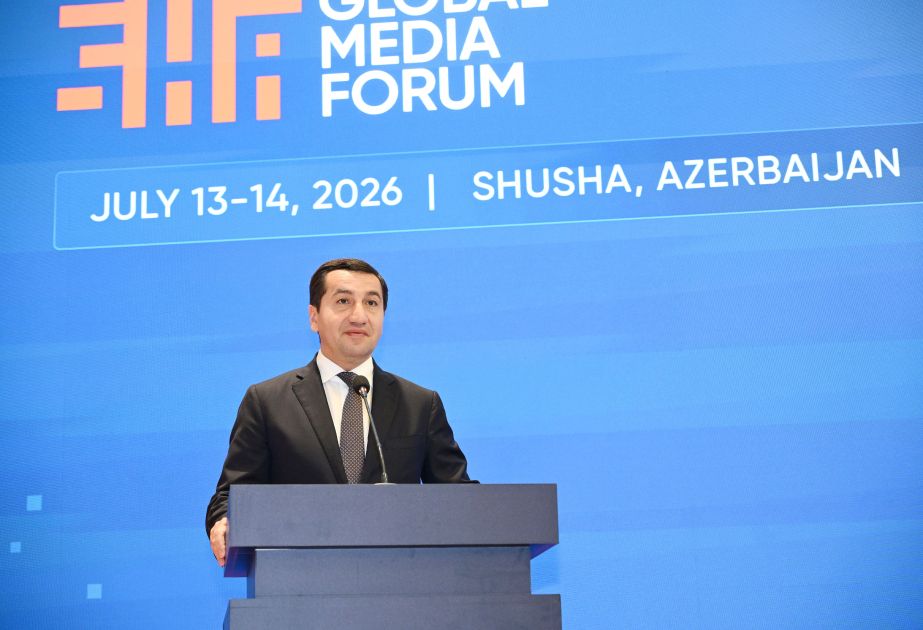
The event opened with a video presentation highlighting the forum's objectives and significance, before Hikmet Hajiyev, Assistant to the President of Azerbaijan and Head of the Foreign Policy Affairs Department of the Presidential Administration, delivered the keynote address. The forum is continuing with a series of panel discussions under the theme, "The Role of Media in Promoting Peace: Restoring Truth and Building Trust."
Addressing participants, Hajiyev described Shusha as a uniquely symbolic venue for discussions on the future of global media.
"It is difficult to imagine a more fitting place than the Shusha Global Media Forum to discuss the future of the world's media," he said. "Shusha is not merely a city; it is a symbol. For centuries, it has been one of the intellectual and cultural centers where literature, music, journalism and public thought flourished. Today, it is once again becoming a place where dialogue, ideas and international cooperation are being rebuilt."
He stressed that the Shusha Global Media Forum is more than a conventional conference, calling it a platform where journalists, policymakers, academics and technology leaders explore ways to safeguard one of journalism's most fundamental values—truth.
"In an era when both information and disinformation spread at unprecedented speed, trust often struggles to keep pace," Hajiyev said, noting that artificial intelligence is fundamentally reshaping the media landscape. He argued that peace today depends not only on diplomacy but also on responsible communication, as modern conflicts are fought not only on battlefields but also across the information space.
Hajiyev also warned that despite the end of the armed conflict, revanchist narratives continue to persist in parts of Armenian society and media. According to him, the responsibility of journalists to resist disinformation, reject hate speech and defend factual reporting has therefore become even more significant. He further claimed that some international media outlets continue to portray developments in ways that risk dragging the region back toward the starting point of the former conflict.
Turning to emerging global challenges, Hajiyev highlighted the growing international concern over the impact of social media on children and adolescents. Governments worldwide, he said, are increasingly reassessing how to protect young people from harmful online content, cyberbullying, addictive algorithms and psychological risks while simultaneously safeguarding access to information and freedom of expression.
He emphasized that the debate is not about restricting technological progress but about ensuring that digital innovation advances alongside digital responsibility.
"Every society must strike a balance between innovation, security, parental responsibility and individual rights," Hajiyev said. "There is no universal solution, but there is a shared responsibility to place the well-being of the younger generation at the center of policymaking."
The forum continues with panel sessions examining the challenges facing global journalism, the spread of disinformation, the growing influence of artificial intelligence on media, and the role of responsible reporting in strengthening international trust and supporting lasting peace.
Here we are to serve you with news right now. It does not cost much, but worth your attention.
Choose to support open, independent, quality journalism and subscribe on a monthly basis.
By subscribing to our online newspaper, you can have full digital access to all news, analysis, and much more.
You can also follow AzerNEWS on Twitter @AzerNewsAz or Facebook @AzerNewsNewspaper
Thank you!